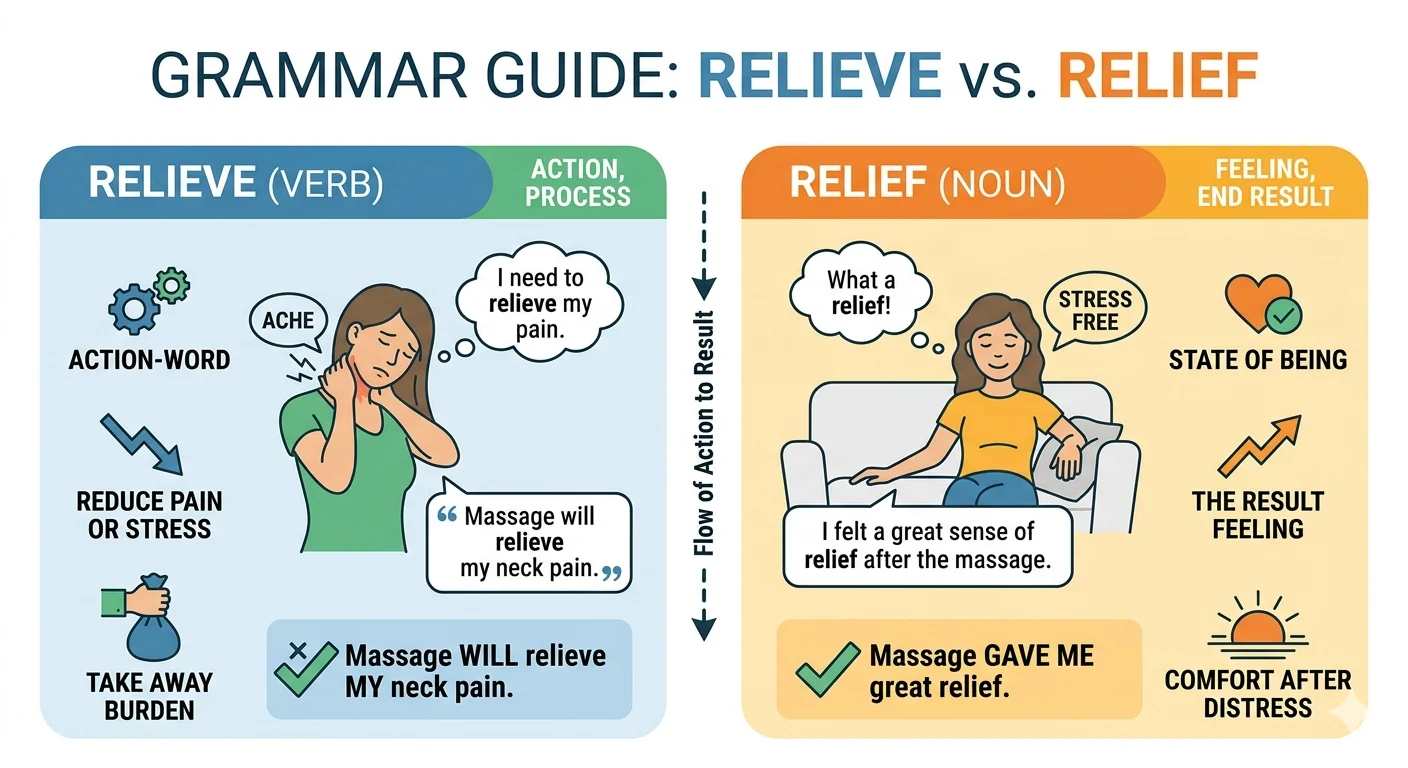
You are writing a sentence and suddenly stop: “Is it relieve or relief?”
This small confusion causes big mistakes. Many people write “I feel relieve” or “relief pain”, which is grammatically incorrect. Using the wrong word in emails, exams, or online articles can make your writing look unprofessional or unclear.
If you’ve ever searched:
- relieve or relief meaning
- I feel relief or relieve
- relieve or relief stress
you are in the right place.
👉 Here’s the truth: Relieve and relief are related but serve different roles in English grammar. Understanding them will make your writing precise, professional, and clear.
In this guide, you will learn:
- The exact relieve or relief meaning
- When to use each word correctly
- Common mistakes and how to fix them
- Real-life examples in emails, social media, and formal writing
- Tips for professional and academic English
By the end, you will confidently answer “should I use relief or relieve?” every single time.
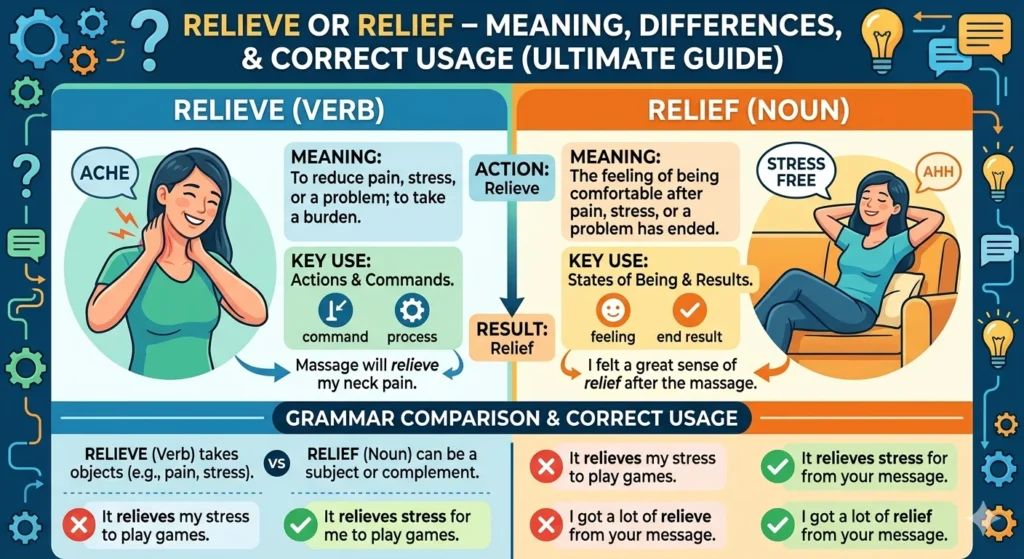
Relieve or Relief means
Relieve vs Relief:
Relieve is a verb (action). Relief is a noun (feeling).
Simple Definitions
- Relieve → Verb → to reduce pain, stress, or pressure
- Relief → Noun → the feeling after pain or stress is gone
Examples
- This medicine will relieve pain
- I feel relief after finishing work
Quick Memory Trick
- Action = Relieve
- Feeling/Result = Relief
This trick works every time.
The Origin of Relieve or Relief
Both words come from the same root in Latin and French:
- Latin: relevare → to raise or lighten
- Old French: relever → to lift
English later developed two forms:
- Relieve → verb (action)
- Relief → noun (result or feeling)
This pattern is common in English grammar:
| Verb | Noun |
|---|---|
| Believe | Belief |
| Relieve | Relief |
This explains the slight spelling change and helps you remember which to use in a sentence.
British English vs American English Spelling
Good news: there is no difference in spelling between British and American English.
- ✔️ Relieve
- ✔️ Relief
Both forms are correct worldwide.
Table Comparison
| Type | Word | Example |
|---|---|---|
| Verb | Relieve | This will relieve stress |
| Noun | Relief | I felt relief after the exam |
Even in professional writing across the globe, the rules remain the same.
Which Spelling Should You Use?
The correct spelling depends on grammar, not geography.
Use Relieve When
- Describing an action
- Example: This medicine will relieve pain
Use Relief When
- Describing a feeling or result
- Example: She felt relief after finishing the task
Fixing Common Confusions
- ✔️ I feel relief (correct)
- ❌ I feel relieve
- ✔️ Relieve stress
- ✔️ Stress relief
- ✔️ Relief from duty
- ✔️ Relieve from duty meaning = to remove responsibility
- ❓ Is it relief or relieve from work?
- ✔️ Correct: relief from work
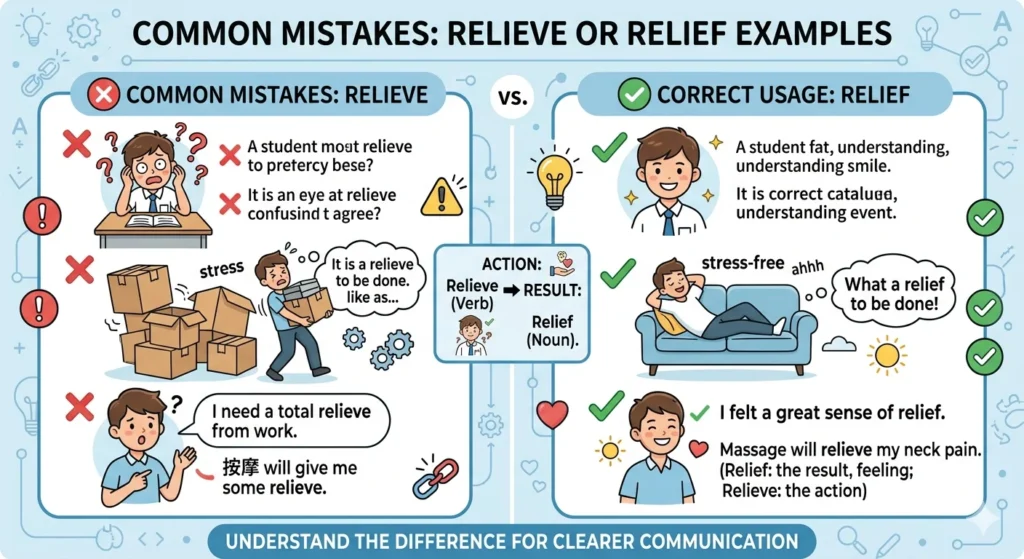
Common Mistakes with Relieve or Relief
Here are the most frequent errors:
❌ I feel relieve → ✔️ I feel relief
❌ What a relieve → ✔️ What a relief
❌ Relief pain → ✔️ Relieve pain
❌ Stress relieve → ✔️ Stress relief
❌ Such a relieve → ✔️ Such a relief
These mistakes are common but easy to correct once you understand the difference.
Relieve or Relief in Everyday Examples
Emails
- I felt great relief after your reply
- This update will relieve stress for the team
Social Media
- Finally done—what a relief
- Music helps me relieve stress
News
- The government announced tax relief
- Steps were taken to relieve pressure on citizens
Formal Writing
- The policy aims to relieve financial burden
- Employees were given relief from duty
Correct Phrases
- Relieve or relief pain → Relieve pain
- Relieve or relief stress → Relieve stress
- I feel relief or relieve → I feel relief

Relieve or Relief – Google Trends & Usage Data
Search data reveals common usage:
Popular Searches
- relieve or relief meaning
- relieve or relief pain
- stress relieve or relief
- what a relieve or relief
Usage by Context
| Context | Common Word |
|---|---|
| Medical | Relieve pain |
| Emotional | Feel relief |
| News | Relief funds |
| Daily Speech | Relief |
Global Trends
- USA/UK → balanced usage
- South Asia → high confusion searches
- Global → relief is more searched than relieve
Reason: people tend to express feelings more than actions.
Comparison Table – Relieve vs Relief
| Feature | Relieve | Relief |
|---|---|---|
| Part of Speech | Verb | Noun |
| Meaning | Reduce pain or stress | Feeling after relief |
| Example | Relieve stress | Feel relief |
| Use | Action | Result |
| Common Phrase | Relieve stress | Stress relief |
Similar Confusing Words
Other common pairs that confuse writers:
- Affect vs Effect
- Advice vs Advise
- Accept vs Except
Mastering these words, along with relieve or relief, improves your English writing dramatically.
FAQs – Relieve or Relief
1. Relieve or relief meaning?
- Relieve = action, Relief = feeling
2. I feel relief or relieve?
- ✔️ I feel relief
3. Relief or relieve pain?
- ✔️ Relieve pain
4. Stress relieve or relief?
- ✔️ Stress relief (noun), Relieve stress (verb)
5. What a relieve or relief?
- ✔️ What a relief
6. Is it relief or relieve from work?
- ✔️ Relief from work
7. How do you say you are relieved?
- I feel relieved / I am relieved / That is a relief
8. To relieve or relief – which is correct?
- Depends on grammar: verb → relieve, noun → relief
Conclusion
The confusion between relieve or relief is common, but now you can use both perfectly.
- Relieve = action (verb)
- Relief = feeling (noun)
Use relieve when reducing stress, pain, or pressure. Use relief when describing the result or feeling.
Mastering this simple rule improves clarity, professionalism, and confidence in writing.
👉 Final Punch Line:
Master this small rule, and your English instantly sounds more natural, precise, and professional

“Rowan Fletcher is a dedicated storyteller who crafts clear, engaging, and helpful content for readers worldwide. Passionate about knowledge and simple learning.”